The IRS has published the 2027 limits for 401(k) plans in Notice 2026-66. This post covers the numbers that change what employees can save, what your plan can hold, and how your plan is tested.


Key Takeaways
- Employees can defer up to $25,500 to a 401(k) in 2027, up $1,000 from 2026.
- Employees who turn 50 or older in 2027 can add a catch-up of $8,500, and employees who turn 60 to 63 can add $11,750 instead.
- If an employee’s 2026 FICA wages from your company were above $155,000, any catch-ups that employee makes in 2027 must be Roth.
- In a calendar-year plan, 2027 pay from your company above $170,000 makes an employee a highly compensated employee for 2028, unless the plan uses the top-paid group election.
Featured Guide
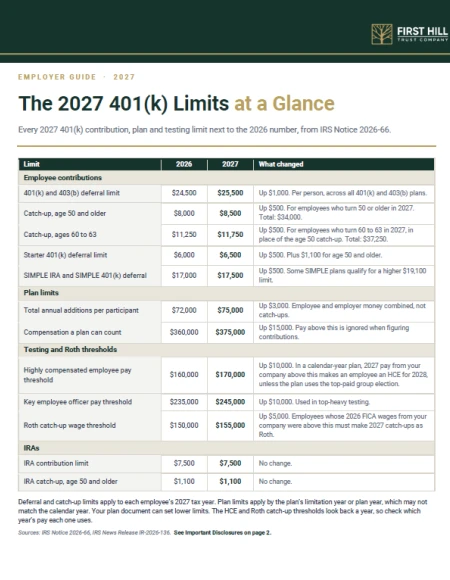
The 2027 401(k) Limits at a Glance
Every 2027 401(k) contribution, plan and testing limit next to the 2026 number, from IRS Notice 2026-66.
What Is the 401(k) Contribution Limit for 2027?
The 2027 deferral limit is $25,500, up from $24,500. The limit is per person, across every 401(k) and 403(b) plan an employee contributes to, and pre-tax and Roth deferrals count toward it together. Starter 401(k) and SIMPLE plans have their own 2027 limits:
- Starter 401(k): $6,500, plus $1,100 for employees who turn 50 or older
- SIMPLE IRA and SIMPLE 401(k): $17,500, with a higher $19,100 limit for some SIMPLE plans
What Are the 2027 401(k) Catch-Up Limits?
- Employees who turn 50 or older in 2027: $8,500, for a total of $34,000
- Employees who turn 60 to 63 in 2027: $11,750 in place of the $8,500, for a total of $37,250
For 2027, the Roth catch-up rule applies to employees whose 2026 FICA wages from your company were above $155,000. Any catch-ups those employees make in 2027 must be Roth contributions, so payroll needs 2026 wage information to apply the rule.
What Other 401(k) Limits Change in 2027?
- Total annual additions: $75,000 per participant. This counts employee and employer money together, not catch-ups.
- Compensation a plan can count: $375,000. Pay above this is ignored when figuring contributions.
- Highly compensated employee threshold: $170,000. In a calendar-year plan, 2027 pay from your company above this makes an employee an HCE for 2028, unless the plan uses the top-paid group election. If the deferral test for highly compensated employees has limited what they can save, a safe harbor plan design is worth a look.
- Key employee officer threshold: $245,000, used in top-heavy testing.
Before Your 2027 Plan Year Starts
Update the deferral and catch-up maximums in payroll, and flag every employee whose catch-ups must be Roth. If a 3(16) plan administrator runs your plan’s operations, confirm it has the new numbers too. Download The 2027 401(k) Limits at a Glance above to keep every 2027 limit on one page, or Schedule a Brief Review with our team to go through your plan setup.
Plan Sponsor FAQs
No. The $25,500 limit applies only to employee deferrals. The match counts toward the $75,000 total annual additions limit.
No. The IRA limit stays at $7,500, and the IRA catch-up stays at $1,100.
Continue Reading
Sources
- Internal Revenue Service, Notice 2026-66 (2027 cost-of-living adjustments for retirement plans)
- Internal Revenue Service, News Release IR-2026-136
- 26 U.S.C. 402(g), Limitation on Exclusion for Elective Deferrals
- 26 U.S.C. 414, Definitions and Special Rules (highly compensated employees and catch-up contributions)
- 26 U.S.C. 415(c), Limitation for Defined Contribution Plans
Important Disclosures
First Hill Trust Company is a Washington State-chartered trust company. Investment advisory services are provided by BAC Capital Advisors, an SEC-registered investment adviser and a wholly owned subsidiary of First Hill Trust Company. Registration does not imply a certain level of skill or training. This article is educational. Neither First Hill Trust Company nor BAC Capital Advisors is acting as ERISA counsel or tax counsel to any plan or plan sponsor, and nothing here replaces advice from qualified counsel about your own plan.
Accuracy and currency. Statutory provisions and regulatory descriptions in this article were checked against the cited primary sources as of the date of publication, but First Hill Trust Company and BAC Capital Advisors make no representation or warranty as to the accuracy, completeness, or timeliness of the information, and accept no liability for actions taken in reliance on it. Regulations and guidance change. Confirm current requirements with qualified counsel.
Educational purpose only. Provided by First Hill Trust Company for general informational and educational purposes only. It is not legal, tax, accounting, investment, or fiduciary advice, does not constitute a recommendation regarding any plan, investment, strategy, or course of action, and does not consider any recipient’s specific circumstances. Consult your own qualified advisors before acting.
No offer, agreement, or commitment. Nothing in this material constitutes an offer, solicitation, agreement, or commitment to provide any particular service or to assume any particular responsibility. Descriptions of what a trustee, administrator, adviser, committee, employer, or other party “may” or “can” do are illustrative of how such arrangements commonly work and do not describe the terms of any specific engagement. The actual services provided, the allocation of responsibilities, the scope of any delegation, and the duties of any party are governed solely by the applicable plan documents, trust agreement, advisory agreement, and written service agreements. In the event of any inconsistency, those documents control.
Services and regulatory status. First Hill Trust Company and its affiliates offer retirement plan services, recordkeeping and administrative services, trust and fiduciary services, investment advisory services, and group benefits services, in each case subject to applicable regulatory requirements and the terms of the relevant agreements. Not all services are offered to all clients, in all states, or in all circumstances. Investment advisory services are offered through an affiliated investment adviser; a copy of its Form ADV Part 2A is available upon request. Insurance and group benefits products are offered through appropriately licensed entities. The availability and scope of any service depend on eligibility and the applicable agreements.
Fiduciary status under ERISA. Fiduciary status under the Employee Retirement Income Security Act of 1974, as amended (“ERISA”), is determined based on the functions performed and the authority exercised, not on titles or labels. Whether any particular party is acting as a fiduciary, and the scope of any related duties or potential liability, depends on the facts and circumstances specific to the plan and the relationship. Engaging a trustee, adviser, or other service provider does not eliminate a plan sponsor’s or committee’s own fiduciary responsibilities, including the duties to prudently select and monitor any party to whom responsibilities are delegated.
Affiliated entities and conflicts of interest. First Hill Trust Company is affiliated with other entities, including an affiliated investment adviser and entities providing administrative, trust, or other services. These relationships may create conflicts of interest, including where an affiliate is engaged or compensated in connection with a plan. Such conflicts and compensation are described in the applicable service agreements and the affiliated adviser’s Form ADV Part 2A; fiduciaries should consider them when evaluating any engagement.
Statutory and regulatory references. References to ERISA, the Internal Revenue Code, and related statutory or regulatory provisions are general summaries only. They are not a substitute for review of the actual statutory text, regulations, or guidance from the Department of Labor, Internal Revenue Service, or other relevant authorities, and they do not address how those provisions may apply to any particular plan, sponsor, fiduciary, or individual. Laws, regulations, and guidance are subject to change and to interpretation by the relevant agencies and courts. Examples, categories, and situations described are simplified for illustration and may not reflect the requirements or circumstances of any particular plan or person.
No guarantee of results; investment risk. References to governance, fiduciary practices, risk reduction, or outcomes describe common industry approaches and potential benefits, not promises or guarantees of any result, of compliance, or of protection from liability, loss, or claims. All investing involves risk, including possible loss of principal; diversification does not ensure a profit or protect against loss. Past performance does not guarantee future results.
For more information, contact First Hill Trust Company at (206) 625-1800.
Related Articles
-

Washington Saves Mandate: What Are Employers Required to Do?
The post explains who the Washington Saves mandate applies to, the steps an employer has to take and the deadlines if it signs up for the state program, what it costs, and which retirement plans, like your own 401(k), meet the requirement instead.
-
What Does a 401(k) Recordkeeper Do?
The recordkeeper keeps your retirement plan's books. This post discusses what that covers, how it differs from the TPA, the custodian, and the trustee, and which jobs stay with your company no matter who you hire.
-
Traditional 401(k) vs. Safe Harbor 401(k): Everything You Need to Know
A safe harbor 401(k) requires the company to contribute and skips the yearly ADP test. A traditional 401(k) leaves contributions optional and has to pass it. Here’s what each one requires.
-
What is a 3(16) Plan Administrator?
Every retirement plan has a plan administrator. If your plan document does not name one, the job falls to you. Here is what the role covers and what a 3(16) provider can actually take off your hands.